
Interview, Stefan Auerbach, CEO Utimaco
What has been the evolution of the HSM market in recent years?
Where is the company going?
The Hardware Security Module (HSM) market has been growing steadily. According to research we did with IDC last year, we expect the HSM market to grow from 550m Euro in 2020 to 819m Euro in 2014, with most of the growth coming from General Purpose HSMs.

Utimaco has not only participated in that growth but has actually been growing much faster than the HSM market: within the past three years, we have doubled our revenue, both through organic growth and several strategic acquisitions that enabled us to expand our product and solution portfolio as well as our regional presence. Our plan is to continue on that growth path, supported by the increasing need for cybersecurity solutions in our digitized connected world.
What do you think is driving your demand?
We see
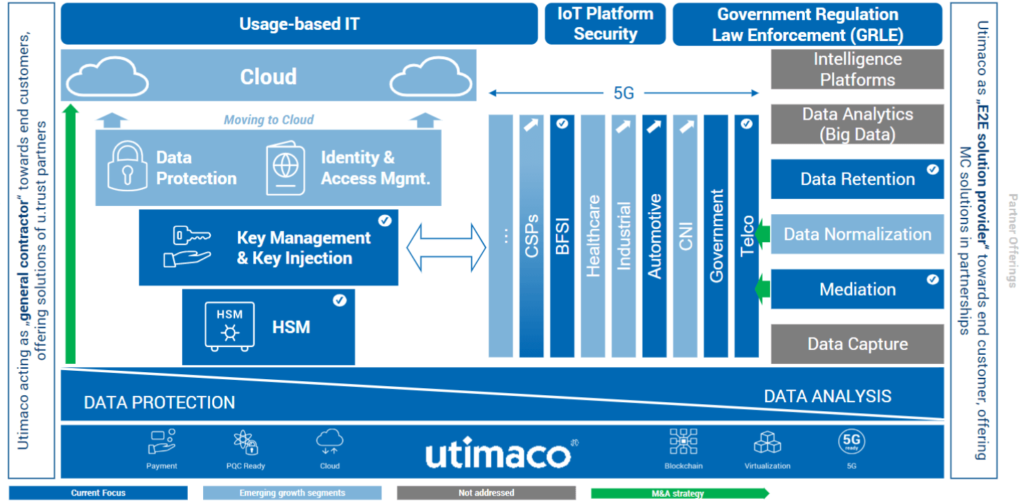
three main trends that will be driving our business over the next few years: Usage-based
IT, IoT Platform Security and Government Regulation.
Enterprises
are increasingly migrating to public and private cloud services which allows
them to create an IT infrastructure that is flexible and adaptable to their
changing IT requirements. This trend has even gained in momentum with the
corona pandemic. However, it tends to make IT infrastructures more complex, and
it makes key sovereignty a new concern for organizations. Often, they will be
using a combination of Cloud Service Providers (CSP) instead of relying
on only one (according to a Kentik report released in 2019, 58% of business
professionals reported using more than one of the three major cloud service
providers Amazon Web Services (AWS), Microsoft Azure, and Google Cloud).
Managing security and key sovereignty in these Multi-cloud environments
is a major challenge that Utimaco can help solve by enabling them to
retain control over data encryption and encryption key management.
Secondly,
we have heard a lot about the Internet of Things (IoT) over the past
years, and with 5G becoming more and more available, this enables new IoT
business models across various industries which in turn require secure key and
access management. For example, OEMs in the Automotive industry need to
orchestrate complex and decentralized technical cybersecurity architectures to
identify and manage connectivity components, secure data and OTA transmissions.
We are working with Tier1 automotive suppliers to protect components from
manipulation and hacking with our key injection and key management solutions.
The automotive manufacturers do this to secure their systems of course, but
also to comply with regulation such as the IEC 62443 set security
standard for Industrial Automation and Control Systems (IACS) in production
plants as well as the UNECE WP.29 defining cybersecurity requirements for Electronic
Control Units (ECU).
Regulation
like this is another key driver for our business, either through the
introduction of new regulation e.g., in IoT to address vulnerability issues or
with standards such as PSD2 or eIDAS which aim at giving consumers more
flexibility and more security in digital financial transactions. You could say
that defining a secure, authenticated, tamper-proof digital identity to
guarantee transparency and trust is the ultimate aim of most regulations, and
creating that kind of trust trough security is our core business.
Is the market prepared as HSM as-a-service proposal?
We believe
that the as-a-service model will become an integral part of almost every
business infrastructure. We have started developing cloud-service based
solutions for our portfolio several years ago and have acquired the British
Payment HSM as-a-service specialist MYHSM at the end of last year to strengthen
our position in that area.
The corona
pandemic has certainly helped to accelerate the trend towards service-based
models as they offer great advantages in terms of agility and flexibility.
Consuming a highly sophisticated security feature like an HSM in a service
model by specialized providers with excellent expertise in that area also
solves the severe skill shortage issue that many organizations already face
today.
We see
strong interest in our as-a-service offerings, both from HSM “newcomers” like
Fintech, that cannot rely on the large IT infrastructure of
traditional banks but still are required to comply with the same security
regulations, as well as from long-term on premise HSM customers that are
looking to complement their existing HSM installations with as-a-service
capabilities to increase performance during peak times as needed.
. In the last year, Utimaco has acquired three
companies (MYHSM, exceet Secure Solutions and REALSEC) and there has been a
change in the shareholders (SGT Capital). What has been the impact of these
acquisitions? What is the current situation of the company?
The
acquisitions of MYHSM, exceet and REALSEC are part of our strategic plan to
grow Utimaco by strengthening and expanding our solution portfolio
as well as our global presence. We are already having great customer
conversations for example through the combination of our key management and
PKI solutions or with REALSEC customers who now have access to Utimaco’s cloud
and as-a-Service offerings. While Utimaco already had a strong presence in Europe
and the US, we can now also serve Spain and the big Latin
American market, and we are actively looking into increasing our
footprint in the APAC region where fast digitization creates a very
interesting market and demand for our cybersecurity solutions.
Utimaco is a very
healthy and dynamic company, and we are confident that we can maintain our
course of on average 20% year over year growth. The change in shareholders to SGT Capital is
still subject to approval by the authorities, we expect the process to be
closed in the next few months.
What is your customer profile?
Our
customers are large enterprises and institutions, traditionally in the banking
and financial services and the telecommunications industries, but more
and more also in the automotive and Industrial IoT space. Government
bodies and authorities are also long-term customers, and every organization
that is part of critical infrastructures has always had demand for
cybersecurity solutions like ours.
Additionally,
we have a global partner network and through their often very specialized
solutions we are also addressing other market segments or regional markets
where Utimaco itself does not have a presence.
What is the positioning of Utimaco against technologies such as blockchain? 5G? IoT?
Both 5G
and IoT are very important drivers for our business, I
mentioned IoT Platform Security as a key driver earlier. The implementation of
IoT is often closely linked to 5G but 5G also creates data encryption
requirements that we address with our telecommunications customers.
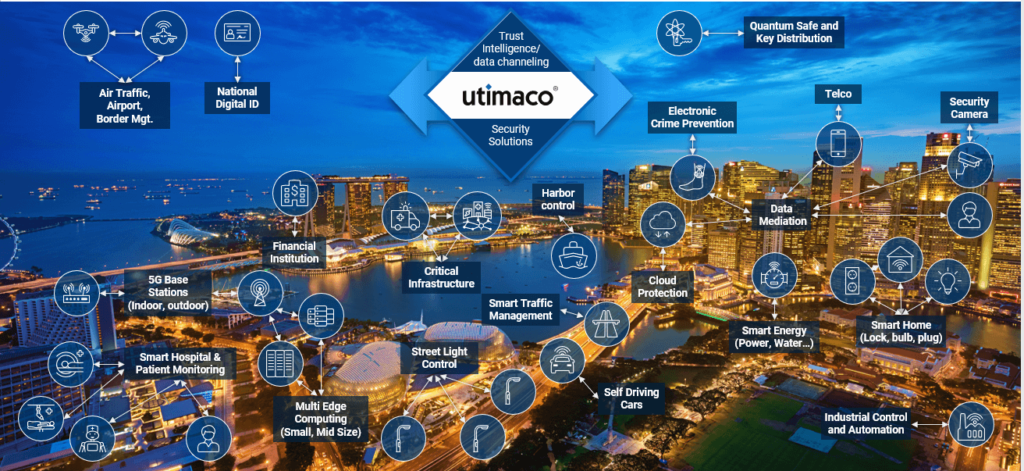
We have
created the Smart City overview below that shows our ambition and
relevance in both areas, as such a connected Smart City depends on 5G and IoT
to be realized, but it also highlights that Utimaco’s cybersecurity solutions
are vital to ensuring security, transparency, data integrity and data
intelligence in the entire ecosystem and are effectively its root of trust.
Blockchain, too, is a very interesting and highly relevant technology that we and REALSEC have been investing in: Blockchain technology enables companies to evolve their digital business processes and include critical supply chains in a highly secure manner. The auditability of transactions in the blockchain is the core of its success, but as more and more companies develop and deploy blockchain technologies, it is essential to adequately protect the transactions they store. An HSM is crucial to securing blockchain systems to cryptographically protect the information stored in them, maintain information integrity, and ensure audit compliance. With Block-safe, launched in 2019, we have developed a product that enables companies to generate, manage and protect cryptographic keys for blockchain applications.
What plans do you have for the Spanish languages markets? Relationship with the distribution channel?
The
Spanish-speaking market is very important for us, and we want to build on the
excellent position and reputation that REALSEC has by
ensuring continuity in customer service and its high product quality. At
the same time, we believe that customers in those market can and will benefit
from the new portfolio elements that Utimaco can offer – I think I
mentioned earlier that we have seen almost instant interest and positive
feedback for example on our cloud and as-a-service solutions.
We are all
very excited about the opportunities created by the combined strength of
Utimaco and REALSEC, not only with our direct customers but also with our
channel partners.
Worried about quantum computing? and its impact on HSMs?
I am glad
you mention quantum computing and by extension post quantum
cryptography, as this is something we have identified early on as a very
relevant issue and have been working on for years.
Many forms
of asymmetric cryptography use 256-bit encryption, generally accepted as
the gold standard, and breaking that encryption by correctly guessing a 256-bit
encryption key would take millions of years. However, for quantum computers
this operation could take hours, maybe even minutes. Therefore, quantum computing
can be a worry for encryption algorithms in use today, but only if you consider
this as a topic in the far away future that you need not address today.
It is true
that we do not know when quantum computers will become available, but just look
at the progress made by Chinese scientists who claim to have built not one but
two quantum computers that are ten million times faster than even the most
powerful conventional supercomputers and one million times more powerful than
Google’s Sycamore processor. What organizations can and should do as soon as
possible is prepare: analyse your data protection requirements today and see
where quantum computing will make you vulnerable.
We have created a PQC Consultancy program to help companies in that analysis and the next steps, i.e. creating a PQC transition roadmap. https://www.utimaco.com/services/consultancy/pqc-consultancy
Tools like
our Q-Safe simulator or our Q-Safe firmware extension allow them to
experiment with the impact of quantum-safe algorithms on their IT
infrastructure or even implement some of the new encryption algorithms today to
become crypto-agile.
Coming
back to your question: we are not worried that quantum computing will harm HSMs
or our business as we see this as an evolution of cryptography and encryption
technology. We have been preparing and will continue to create trust in the quantum
age.
Stefan Auerbach
CEO Utimaco